

Canton Fair preparation
What Time Should You Arrive at Canton Fair?
Plan your Canton Fair arrival with current badge-counter hours, metro exits, a visual day timeline, a travel-buffer chart and practical tables for transport, meetings and departure.
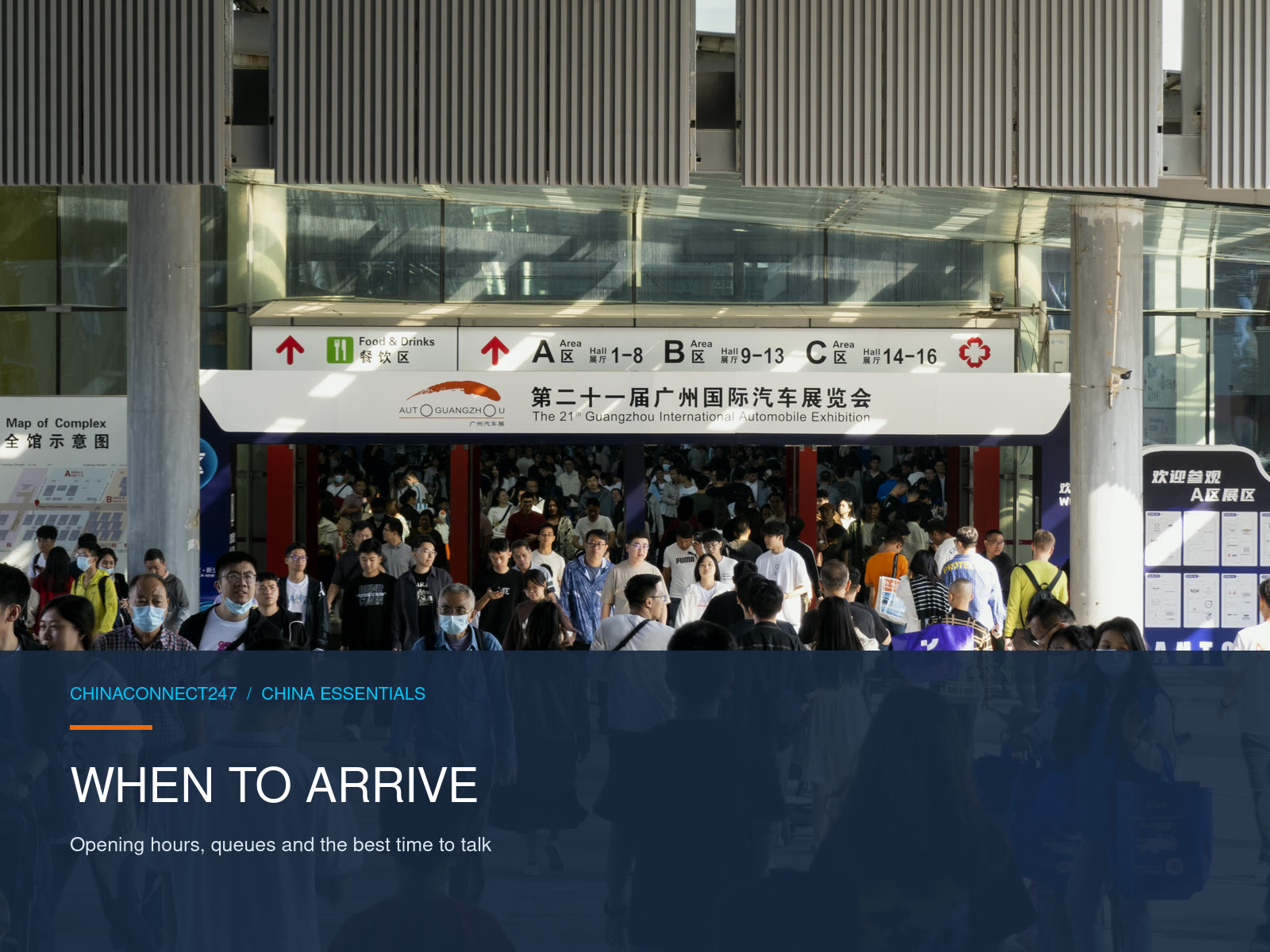
A good Canton Fair morning starts with the right phase, badge status and entrance—not just an early alarm. This guide combines current autumn 2026 official notices with a practical plan for transport, meetings, meals and the return journey.
Quick answer
Already have your badge? Aim for the correct entrance around 08:45–09:00 if your first meeting is important; the published exhibition hours are 09:30–18:00. Need a badge? Current on-site exhibition-day counters open at 08:30, and airport counters follow a different schedule. Add security and walking time, and treat suggested arrival targets as planning buffers rather than guaranteed entry times.
Official hours and what they mean for your arrival
The organizer lists daily exhibition hours of 09:30–18:00: an 8-hour-30-minute exhibition window, not a promise of immediate entry at 09:30. All times in this guide are Guangzhou local time, China Standard Time (UTC+8), with no daylight-saving change.
The 140th Canton Fair runs in three phases: 15–19 October, 23–27 October and 31 October–4 November 2026. The gaps between phases are not normal exhibition days. Check that your product category is in the phase you are attending before booking transport.
Source check: 17 October 2026. Hours and dates come from the organizer; badge-counter schedules and station/exit details below come from Guangzhou government guides updated on 15 October 2026. Check official notices again before travelling. Arrival targets, meal windows, buffers and meeting blocks are ChinaConnect247 planning suggestions, not official admission times or measured crowd forecasts.
Choose an arrival target that fits your badge status
- Suggested target
- Reach the relevant entrance around 08:45–09:00
- Protect your first meeting
- Allow for security and the walk to the booth; early arrival does not mean early hall entry.
- Suggested target
- Be ready for the correct counter's published opening; on-site exhibition-day service starts at 08:30
- Protect your first meeting
- Do not promise a 09:30 booth meeting until collection and entry are complete.
- Suggested target
- Use the badge-holder plan
- Protect your first meeting
- Verify that your badge and identification match the current admission requirements.
- Suggested target
- Choose a later first meeting or arrive in Guangzhou the day before
- Protect your first meeting
- Baggage, immigration, connections and luggage storage are separate from the fair commute.
- Suggested target
- Message the supplier and go directly to the highest-priority hall
- Protect your first meeting
- A focused visit is more useful than rushing across every area.
| Your situation | Suggested target | Protect your first meeting |
|---|---|---|
| Badge already collected; first meeting matters | Reach the relevant entrance around 08:45–09:00 | Allow for security and the walk to the booth; early arrival does not mean early hall entry. |
| First badge still needed | Be ready for the correct counter's published opening; on-site exhibition-day service starts at 08:30 | Do not promise a 09:30 booth meeting until collection and entry are complete. |
| Badge collected the day before at an official location | Use the badge-holder plan | Verify that your badge and identification match the current admission requirements. |
| Arriving by flight or intercity train that morning | Choose a later first meeting or arrive in Guangzhou the day before | Baggage, immigration, connections and luggage storage are separate from the fair commute. |
| Late arrival with a valid badge | Message the supplier and go directly to the highest-priority hall | A focused visit is more useful than rushing across every area. |
An 08:45 target is a buffer, not an instruction to queue unnecessarily or enter before staff permit it. If your morning has no fixed meeting, adjust the target to your circumstances.
Current badge-counter hours: do not confuse them with hall opening
Preregister in the official Buyer Service System and save your receipt offline. Bring the original valid identification used for registration, the receipt and a company business card. Guangzhou's guide says buyer badges can be used across multiple sessions; confirm the condition of your existing badge before joining a new-issuance queue.
- Dates in 2026
- 12–13 October
- Published hours
- 09:00–18:00
- Dates in 2026
- 14–19 October
- Published hours
- 08:30–18:00
- Dates in 2026
- 22 October
- Published hours
- 09:00–18:00
- Dates in 2026
- 23–27 October
- Published hours
- 08:30–18:00
- Dates in 2026
- 30 October
- Published hours
- 09:00–18:00
- Dates in 2026
- 31 October–4 November
- Published hours
- 08:30–18:00
| 140th fair on-site registration service | Dates in 2026 | Published hours |
|---|---|---|
| Phase 1, advance service | 12–13 October | 09:00–18:00 |
| Phase 1, day before and exhibition days | 14–19 October | 08:30–18:00 |
| Phase 2, advance service | 22 October | 09:00–18:00 |
| Phase 2, exhibition days | 23–27 October | 08:30–18:00 |
| Phase 3, advance service | 30 October | 09:00–18:00 |
| Phase 3, exhibition days | 31 October–4 November | 08:30–18:00 |
Guangzhou also lists Baiyun Airport counters at Terminal 2 international arrivals and Terminal 3 international arrivals near Gate 74, open 08:00–24:00 on 12–19 October, 22–27 October and 30 October–1 November. These airport dates do not cover every Phase 3 day. Railway-station, ferry-terminal, Hong Kong and designated-hotel collection points also exist, but do not assume they share airport or complex hours.
Overseas Chinese applying with a Chinese passport and overseas residence or visa documentation are directed to the complex's registration offices. Accompanying Chinese personnel have a separate badge process; the government guide says to apply at least two days ahead. Check the official eligibility instructions for your own situation.
Match the metro exit to the correct exhibition area
Save the supplier's phase, area, hall and booth, then choose the station. A station name alone is not an entrance plan. Use the current complex map and staff instructions when temporary controls apply.
- Station and line
- Xingangdong, Line 8
- Published access guidance
- Exit A → Gate 6
- Station and line
- Pazhou, Line 8
- Published access guidance
- Exit A or B → Gate 4
- Station and line
- Pazhou, Line 8
- Published access guidance
- Exit C; walk about 300 metres west
- Station and line
- Pazhou, Line 11
- Published access guidance
- Exit E or F → Gate 3
- Station and line
- Xingangdong, Line 8
- Published access guidance
- Exit A
- Station and line
- Pazhou, Line 8 or Line 11
- Published access guidance
- Line 8 exits A/B; Line 11 exit E
- Station and line
- Pazhou, Line 8
- Published access guidance
- Exit C
| Destination | Station and line | Published access guidance |
|---|---|---|
| Areas A and D | Xingangdong, Line 8 | Exit A → Gate 6 |
| Area B | Pazhou, Line 8 | Exit A or B → Gate 4 |
| Area C | Pazhou, Line 8 | Exit C; walk about 300 metres west |
| Area B | Pazhou, Line 11 | Exit E or F → Gate 3 |
| Area D badge office | Xingangdong, Line 8 | Exit A |
| Area B badge office | Pazhou, Line 8 or Line 11 | Line 8 exits A/B; Line 11 exit E |
| Area C badge office | Pazhou, Line 8 | Exit C |
The Line 11 distinction matters: the arrival guide lists exits E/F for Area B admission, while the badge guide specifically identifies exit E for the Area B badge office. Follow the signs for the service you actually need.
Compare morning transport without relying on a fixed journey time
- Most useful when
- Your hotel has a workable connection to Line 8 or Line 11
- What to confirm the night before
- Correct station, exit and area; allow for transfers, platform controls and walking.
- Most useful when
- Your hotel confirms a service for your exact fair dates
- What to confirm the night before
- Reservation, boarding time, destination area, return pickup and what happens if you miss it.
- Most useful when
- You have a practical pickup point or need more flexible access
- What to confirm the night before
- Current designated drop-off zone and a backup; road traffic and pickup waits can change.
- Most useful when
- Your hotel genuinely has a suitable pedestrian route
- What to confirm the night before
- The entrance you need, crossings, weather and luggage; straight-line distance is not walking distance.
- Most useful when
- The current timetable fits your route
- What to confirm the night before
- Actual service and ticket availability; immigration or onward transfers where relevant.
| Option | Most useful when | What to confirm the night before |
|---|---|---|
| Metro | Your hotel has a workable connection to Line 8 or Line 11 | Correct station, exit and area; allow for transfers, platform controls and walking. |
| Hotel shuttle | Your hotel confirms a service for your exact fair dates | Reservation, boarding time, destination area, return pickup and what happens if you miss it. |
| Taxi or ride-hailing | You have a practical pickup point or need more flexible access | Current designated drop-off zone and a backup; road traffic and pickup waits can change. |
| Walking from a nearby hotel | Your hotel genuinely has a suitable pedestrian route | The entrance you need, crossings, weather and luggage; straight-line distance is not walking distance. |
| Intercity rail or ferry | The current timetable fits your route | Actual service and ticket availability; immigration or onward transfers where relevant. |
Do not copy a journey time from another buyer's hotel. Check a current local route planner and add each part of your own door-to-booth journey.
Build a door-to-booth buffer
This is an illustrative 85-minute plan, not a measured average or queue prediction. Replace every allowance with your own route and conditions. It assumes you already have your badge; badge collection is extra.
- Example minutes
- 10
- Example minutes
- 35
- Example minutes
- 15
- Example minutes
- 15
- Example minutes
- 10
| Journey component | Example minutes |
|---|---|
| Hotel-to-station or vehicle pickup | 10 |
| Main transport journey | 35 |
| Station or drop-off to the correct entrance | 15 |
| Security and badge checks | 15 |
| Entrance-to-first-booth walk | 10 |
The example totals 85 minutes. For a 10:00 booth meeting, that means leaving at 08:35 before adding any extra contingency. If a map only quotes the 35-minute main journey, it leaves 50 minutes of this example unaccounted for. Security, queues and walking can be shorter or longer: this chart is an accounting tool, not a guarantee.
- 10
Hotel-to-station or vehicle pickup
- 35
Main transport journey
- 15
Station or drop-off to the correct entrance
- 15
Security and badge checks
- 10
Entrance-to-first-booth walk
85Example minutes
A sample fair-day timeline
This sample uses the official 09:30–18:00 exhibition window but divides it into suggested activities, not recommended crowd levels. Confirm that the right supplier representative is available. No hour is guaranteed quiet.
- Suggested activity
- Entry, orientation and walk to the first hall
- Suggested activity
- Priority supplier conversations in one hall cluster
- Suggested activity
- Early lunch and water break if convenient
- Suggested activity
- Planned meetings and product comparisons
- Suggested activity
- Rest, battery check and capture missing notes
- Suggested activity
- Shortlisted-supplier revisits and next-action agreements
- Suggested activity
- Flexible final visit, exit walk and return transport
| Time | Suggested activity |
|---|---|
| 09:30–10:00 | Entry, orientation and walk to the first hall |
| 10:00–11:30 | Priority supplier conversations in one hall cluster |
| 11:30–12:15 | Early lunch and water break if convenient |
| 12:15–14:30 | Planned meetings and product comparisons |
| 14:30–15:00 | Rest, battery check and capture missing notes |
| 15:00–16:45 | Shortlisted-supplier revisits and next-action agreements |
| 16:45–18:00 | Flexible final visit, exit walk and return transport |
Choosing to leave at 16:45 is optional: you give up the last 75 minutes of the published exhibition window. Stay for a valuable confirmed meeting if your onward travel allows it. Earlier departure may spread your journey away from closing time, but it does not guarantee a quiet platform or available taxi.
09:30–10:00
Entry, orientation and walk to the first hall
10:00–11:30
Priority supplier conversations in one hall cluster
11:30–12:15
Early lunch and water break if convenient
12:15–14:30
Planned meetings and product comparisons
14:30–15:00
Rest, battery check and capture missing notes
15:00–16:45
Shortlisted-supplier revisits and next-action agreements
16:45–18:00
Flexible final visit, exit walk and return transport
Protect useful supplier meeting windows
Before the fair, confirm the contact person's name, WeChat or other agreed channel, booth and meeting purpose. Ask whether the person who handles your product category, export market or technical questions will be present.
- First conversation: check the product fit, supplier role, indicative minimum order and the next evidence needed.
- Comparison visit: bring the same specification questions to each supplier so quotations remain comparable.
- Return visit: agree who will send the quotation, sample details, supporting documents and the next follow-up date.
- If you are delayed: message the supplier before the meeting time and propose a realistic alternative.
A suggested 30-minute meeting slot is a planning choice, not a claim that every qualification conversation can be completed in 30 minutes. Leave walking time between halls, especially across areas.
Lunch, connectivity and accessibility can change the plan
Try an earlier or later lunch window if it fits the meetings, rather than assuming food and seating will be available at noon. Food queues vary by location and day; no reliable wait-time dataset was found for this guide. Carry water and a snack where venue rules permit, and make sure your preferred payment method works before the visit.
Save the hotel name and address in Chinese, your first booth, badge receipt, map and supplier contacts offline. Charge the phone and power bank before leaving. At each useful booth, record the company, hall, booth, product and next action before moving away; My Fair can keep these together.
If you need step-free access, mobility support, a companion arrangement or another accessibility service, confirm the exact gate, lift route and assistance with the organizer in advance. Do not assume a station exit has the facilities you need merely because it is closest to the hall. Allow extra transfer time and plan rest stops.
Plan the return journey before the final meeting
Confirm a specific pickup area and return time if you rely on a hotel bus or driver. If leaving by metro, follow staff routing and current platform controls. Guangzhou's current guide also mentions tram, intercity-rail and ferry connections, but it does not establish a guaranteed timetable for your trip. Do not rely on a temporary shuttle or airport link without checking the date, phase and last departure.
An 18:00 exhibition close is not an 18:00 airport arrival or an 18:05 hotel pickup. A flight or long-distance train needs its own plan for exit walking, transport, baggage collection from the hotel if needed, check-in, security and the operator's required arrival time. Put that deadline into your plan first, then work backwards.
Your night-before checklist
- Confirm the correct phase, date, product category and current 09:30–18:00 exhibition hours.
- Check badge status and the exact pickup office's opening time if you still need collection.
- Save original identification requirements, preregistration receipt and a business card.
- Choose the correct station, exit, area, hall and first booth.
- Confirm the supplier representative and first realistic meeting time.
- Add pickup, transport, entry and walking buffers separately.
- Save the hotel address and first route offline; charge devices.
- Confirm lunch flexibility, accessibility needs and return transport.
Sources and evidence
Open the original publications and product references used in this article.
- 01Canton Fair organizer: session dates and exhibition hourscantonfair.org.cn
- 02Guangzhou government: 140th Canton Fair overseas buyer badge guide, updated 15 October 2026eguangzhou.gov.cn
- 03Guangzhou government: 140th Canton Fair transport guide, updated 15 October 2026eguangzhou.gov.cn
- 04Official Canton Fair Buyer Service Systembuyer.cantonfair.org.cn
- 05Guangzhou Metro official website for current service noticesgzmtr.com
Additional report notes
Guangzhou government: 140th Canton Fair overseas buyer badge guide
Guangzhou government: 140th Canton Fair transport guide
Keep the context with the contact.
Save supplier cards alongside products, quotes, questions, samples, and the next action.