

Canton Fair preparation
How to Plan a Canton Fair Day Without Wasting 6 Hours Walking
A complete route-planning guide for shortlisting suppliers, grouping halls, booking realistic meeting windows, recording booth evidence, and turning a long Canton Fair day into a usable sourcing list.
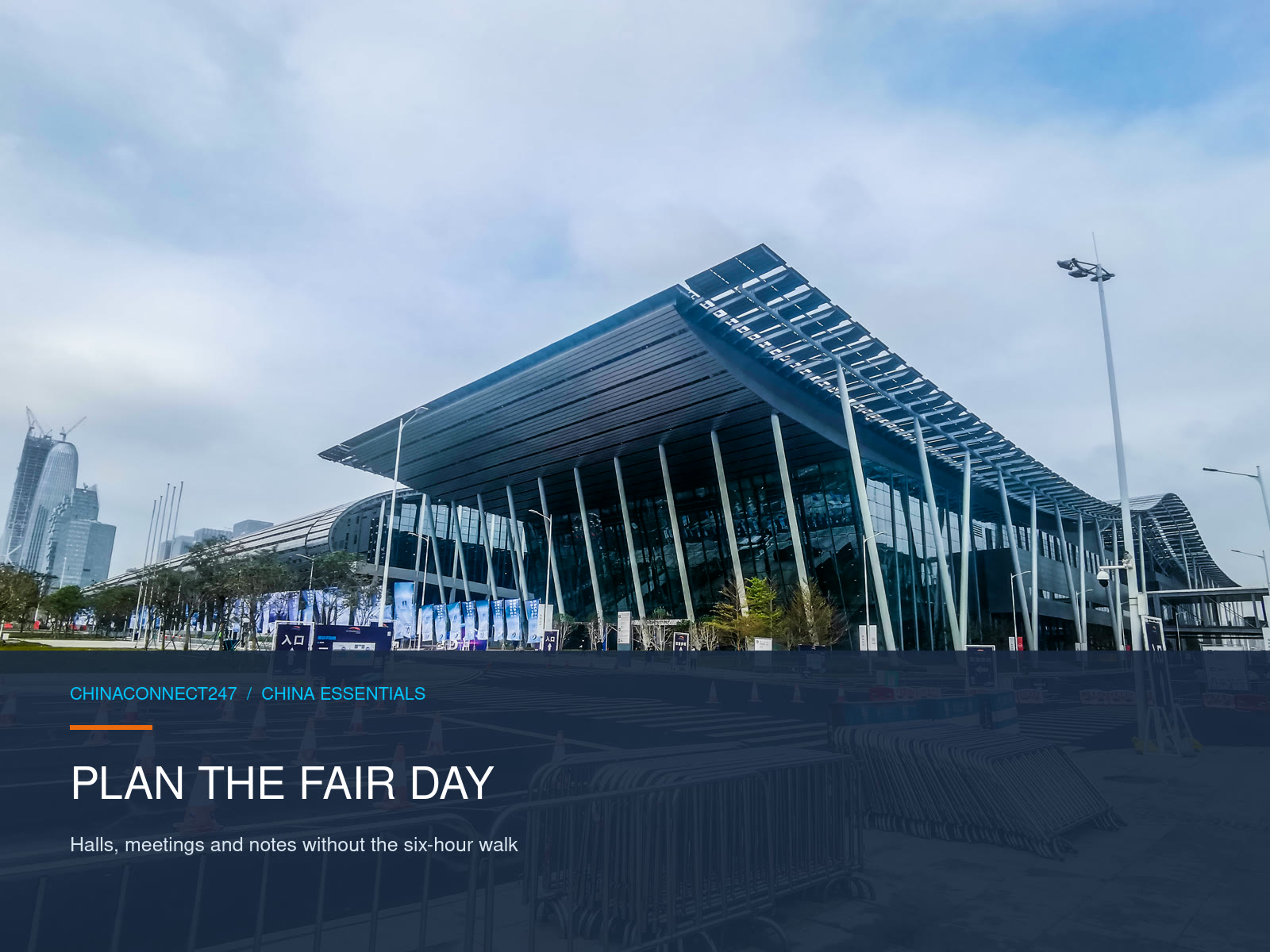
The Canton Fair is easier to navigate when the day is treated as a buying route rather than an open-ended walk. A good plan starts before breakfast: shortlist the suppliers that matter, group them by exhibition area, reserve realistic meeting windows, and decide exactly what evidence you need from each conversation. The objective is not to collect the most steps or catalogues. It is to leave with a short, identifiable list of suppliers and clear next actions.
Quick answer
Build a priority list before leaving your hotel, group suppliers by area and hall, book 30-45 minute meeting windows with buffers, and record the booth number, company, product, price context, photos, and next action before moving on. Review every card and photo for 20-30 minutes each evening. That workflow prevents the common result of a full day of walking with no reliable supplier comparison.
What a successful fair day produces
A successful day does not mean visiting every hall. It produces a small set of supplier records that you can identify and compare after the fair. For each serious lead, you should know:
- Who you met and what role they have.
- Which company and booth you visited.
- Which product or model you discussed.
- What quantity, MOQ, price basis, packaging, and lead time were mentioned.
- Which claims still need verification.
- What the next action is and who owns it.
If you cannot answer those questions, another catalogue or another photograph will not make the lead more useful. Plan the day around the quality of the record you want to create.
Start with the current fair information
The China Import and Export Fair Complex is divided into multiple exhibition areas, and products are distributed by phase and hall. The official map and current fair information are the controlling references. The hall arrangement, entrances, product categories, and event services can change between sessions, so do not build a route from an old blog post or a previous visit without checking it against the current map.
Before the trip, confirm the session dates, phase, product categories, exhibition hours, venue entrance, and any buyer or transport notices. Save the map as a screenshot or PDF for offline use. A map that is available only through hotel Wi-Fi is not a dependable route plan.
1. Build a short supplier shortlist
Start with the official Canton Fair exhibitor search, your own research, introductions, and supplier recommendations. Keep the first list short enough to use. Around 12-20 priority suppliers is usually more practical than trying to cover an entire category. Add a second group of comparison suppliers and a third group of opportunistic stops.
For each priority supplier, write one question that must be answered. Examples include:
- Is the company the manufacturer, an exporter, or another type of supplier?
- What is the MOQ for the exact model and target market?
- Is the displayed price EXW, FOB, or based on another condition?
- Can the supplier provide a sample, test report, or packaging specification?
- What is the realistic lead time after sample approval?
- Which legal entity will appear on the quotation and invoice?
A question turns a booth visit into a qualification task. Without one, the conversation often becomes a general presentation that is difficult to compare later.
2. Put suppliers into route groups
Organize the shortlist in this order: exhibition area, hall, booth, then supplier priority. Group adjacent halls together and avoid crossing the complex for a low-priority visit. A simple spreadsheet or note should have columns for area, hall, booth, supplier, priority, meeting time, key question, and follow-up status.
A practical day may look like this:
- First route block: the highest-priority suppliers in one hall cluster.
- Second route block: adjacent comparison suppliers.
- Midday reset: food, water, charging, and a review of what has actually been captured.
- Afternoon block: the next area or confirmed meetings.
- Final block: one or two high-value follow-ups near your exit route.
The order matters. If a supplier is important enough to justify a cross-complex walk, schedule that visit as a meeting rather than treating it as a casual stop.
3. Add realistic travel and conversation buffers
Do not plan a meeting every 15 minutes. A useful supplier conversation can include product selection, specifications, packaging, quality questions, samples, payment terms, and a handoff to another colleague. It may also take time to find the booth or wait for the right person.
Use 30-45 minute windows for priority meetings and add at least 15 minutes of buffer before the next commitment. Add more time when changing areas, using an unfamiliar entrance, or carrying samples. A schedule with fewer confirmed meetings is stronger than a full schedule that collapses after the first delay.
When booking a meeting, send your name, company, product category, target quantity if known, and the hall and booth. Ask the supplier to confirm the booth location and the person responsible for your category. Save the confirmation with your route notes.
4. Use the booth number as your anchor
Photograph the booth number and company sign before photographing products. This single habit prevents many later identification problems. Then capture only the product information you need: the model, specification sheet, packaging, certifications shown, quotation, and any useful demonstration. Ask permission before photographing people, confidential documents, or screens.
At the end of each conversation, write or record:
- Company name, booth number, contact name, and role.
- Product name, model, material, size, or other distinguishing detail.
- MOQ and target quantity.
- Price and price basis, if stated.
- Sample cost, tooling, packaging, and lead time.
- Markets already served or claimed certifications.
- One unresolved question.
- The next action and due date.
Do this before walking away. Five minutes later, two similar products may already be mixed together in your camera roll.
5. Protect meeting quality
A buyer can waste time by asking the wrong person the right question. At the start of a conversation, establish whether the person can answer about production, export, pricing, quality, or customization. If not, ask for the colleague who can. Record the person's role rather than assuming that every representative is the factory or decision-maker.
Keep a short qualification script ready. Explain your product, target market, expected quantity, required compliance, packaging needs, and buying timeline. Then listen for what the supplier can actually support. If a claim is important, mark it as a claim until documents or other evidence confirm it.
Do not negotiate every detail at the first booth if the basic supplier identity is still unclear. Capture the information needed for comparison, then move to the next planned stop.
6. Use lunch as a route checkpoint
Lunch is not just a break. It is the best time to compare the morning against the plan. Ask:
- Which priority suppliers were completed?
- Which cards have a booth photo and next action?
- Which conversations were too vague to count?
- Which low-priority stops should be dropped?
- Do you still have enough battery and time for the afternoon route?
If the morning ran late, remove detours before the afternoon becomes another unplanned walk. Keep one open slot for a promising discovery, but do not allow every new booth to displace a supplier you came to meet.
7. Run an evening review every day
Reserve 20-30 minutes at the hotel. Match each business card to the booth photo, correct the company name, label product photos, enter the important quote details, and mark the supplier as priority, comparison, or needs verification. Write the next action while the conversation is still fresh.
Separate facts from claims. For example, record “supplier says factory in Guangdong” as a claim, not as a verified factory location. Record “certificate shown at booth” separately from “certificate independently checked.” This distinction makes later supplier due diligence much safer.
Back up the notes and photos. A simple folder structure can use the date, area, hall, booth, and supplier name. If you use a card-scanning or sourcing workflow, complete the scan before moving to the next card.
A reusable day plan
The night before
Check the current official map and fair notices. Confirm your badge, first entrance, route group, first meeting, phone charge, power bank, water, business cards, and offline documents. Send meeting confirmations before sleeping.
Before entering
Arrive with enough time to find the correct entrance, use the restroom, review the route, and reach the first booth without running. Do not spend the first hour wandering while deciding what to do.
During each visit
Anchor the record with the booth number, ask the priority question, capture the product context, and write the next action before leaving.
At the end of the day
Finish the final planned conversation, check the return route, and complete the evening review before fatigue turns every supplier into the same memory.
The best Canton Fair day is not the one with the highest step count. It is the one that leaves you with a short, identifiable, evidence-backed supplier list that can move into quotations, samples, and verification.
Sources and evidence
Open the original publications and product references used in this article.
Keep the context with the contact.
Save supplier cards alongside products, quotes, questions, samples, and the next action.