

Canton Fair buying
The Cheapest Quote at Canton Fair Could Cost You More
Compare Canton Fair supplier quotes beyond unit price. Check specifications, MOQ, packaging, shipping terms, and estimated costs before choosing.
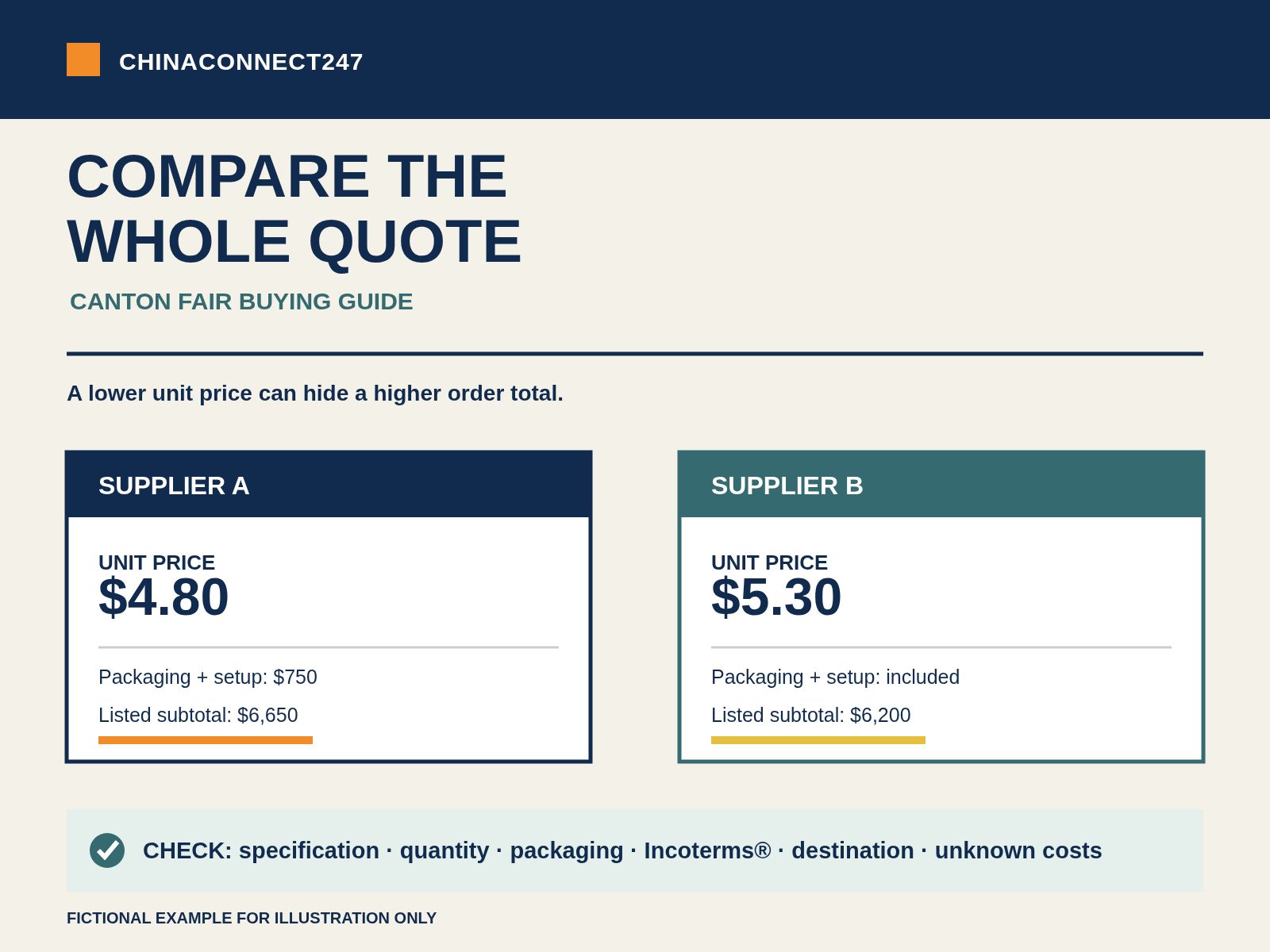
Before you choose a supplier, find out what their price actually includes.
Three booths. Three similar products. Three very different prices.
One supplier says $4.80. Another says $5.30. A third says they can beat both if you order today.
It feels like an easy decision—until you discover that the first price excludes your packaging, applies to a larger order, and covers a different specification from the sample you photographed.
The prices may all be honestly quoted. They may simply describe different purchases.
Before asking for a discount, ask a more useful question:
Are we comparing the same product, in the same quantity, delivered on the same basis?
Quick answer
Compare the exact specification, order quantity, packaging, delivery terms, additional charges, and payment conditions. Keep unknown costs visible. A missing number should never quietly become zero.
1. Start with the product behind the price
Products that look similar can differ in ways that affect performance, durability, and cost.
A lamp may use a different battery. A bag may have a different fabric weight. A metal fitting may use a different grade or finish.
Give each shortlisted supplier the same written requirements. Ask them to identify any differences between their quotation and your requested specification.
For your product, record the details that matter:
- Model or reference number.
- Materials and dimensions.
- Components or performance requirements.
- Included accessories.
- Colour and finish.
- Branding and packaging.
- Required product documents.
Attach the reference photo, but do not rely on the photo to define everything.
A useful question is:
Please confirm that this quotation covers the exact configuration discussed. If anything differs, list the differences separately.
This also makes negotiation clearer. If a supplier offers a lower price, ask what changed.
2. Find out which quantity earns that price
An attractive unit price may apply to an order larger than your planned first purchase.
Ask suppliers to quote your actual starting quantity before comparing their larger-order discounts.
Clarify whether the minimum order quantity—MOQ—applies to the whole order, each product model, each colour, each size, or each packaging option.
For example, MOQ 500 might mean 500 units in one colour, rather than 500 units divided across five colours.
Also ask whether a repeat order has the same minimum as the first order.
A practical request is:
Please quote 300, 500, and 1,000 units using the same specification. Confirm the minimum quantity per colour and packaging design.
Those quantities are examples. Use numbers that fit your business.
3. Ask what packaging included means
A supplier may be quoting basic protective packaging while you are imagining a printed retail box.
Before comparing prices, specify what you need: individual packaging, printed artwork, labels and barcodes, instructions or inserts, protective materials, outer cartons, and any pallet requirements.
Request the packed dimensions, gross weight, and units per carton so a logistics provider can prepare a useful freight estimate.
Then ask whether artwork preparation, printing setup, labels, inserts, and export cartons are included, and which charges apply only to the first order.
4. Understand where the quoted price stops
A quotation should identify the delivery rule and the named place or port.
Terms such as EXW, FCA, and FOB allocate different responsibilities. They cannot be treated as interchangeable labels attached to the same price. ICC guidance explains that EXW leaves export-clearance responsibility with the buyer and is primarily suited to domestic trade. FCA can be appropriate for containerised or multimodal shipments, with export clearance handled by the seller. FOB is for sea or inland-waterway transport, with delivery occurring when goods are on board the vessel. ICC checklist for choosing an Incoterms® 2020 rule
Ask your logistics provider which rule fits the proposed shipment. Request the agreed Incoterms® rule, precise named place or port, and version used.
If a supplier offers DDP, ask who will perform import clearance and how that arrangement works in your destination country. ICC guidance on national regulatory barriers
5. Compare costs to the same destination
Choose one endpoint for your comparison—for example, arrival at your warehouse.
The International Trade Administration describes landed cost as including the product price, freight, insurance, tariffs, taxes, and other fees. It recommends treating these calculations as estimates because charges and rates can change. ITA guidance on total landed cost
Build your comparison using confirmed quotations and clearly identified estimates. Avoid double counting. If a charge is already included in the supplier’s price, do not add it again.
A lower unit price can produce a higher order total
Fictional example for illustration only. These are not market prices, freight estimates, or tax calculations.
Assume both suppliers have been asked to quote the same specification and quantity. Neither goods price includes the additional items listed below.
- Supplier A
- 1,000 units
- Supplier B
- 1,000 units
- Supplier A
- $4.80
- Supplier B
- $5.30
- Supplier A
- $4,800
- Supplier B
- $5,300
- Supplier A
- $450
- Supplier B
- Included
- Supplier A
- $300
- Supplier B
- Included
- Supplier A
- $1,100
- Supplier B
- $900
- Supplier A
- $6,650
- Supplier B
- $6,200
- Supplier A
- $6.65
- Supplier B
- $6.20
| Comparison item | Supplier A | Supplier B |
|---|---|---|
| Quantity | 1,000 units | 1,000 units |
| Quoted unit price | $4.80 | $5.30 |
| Goods subtotal | $4,800 | $5,300 |
| Required packaging, additional | $450 | Included |
| First-order setup charge | $300 | Included |
| Assumed logistics to the same endpoint | $1,100 | $900 |
| Subtotal of listed costs | $6,650 | $6,200 |
| Listed subtotal per ordered unit | $6.65 | $6.20 |
Supplier A has the lower headline price, but Supplier B has the lower subtotal once these items are included. This is not a complete landed-cost calculation. Duties, taxes, insurance, testing, inspection, and other applicable charges would still need to be established.
6. Give every unknown cost a status
Use simple statuses: Included, Quoted, Estimated, Unknown, and Not applicable.
For example, customs charges: unknown is more useful than an empty cell that gets treated as zero. Import duties and taxes depend on destination, classification, and applicable rules. ITA guidance on import tariffs and fees
7. Clarify when the delivery clock starts
Ask whether the period begins after deposit, artwork approval, or sample approval; when production finishes; whether inspection time is included; and what happens if the approved specification changes.
Treat production time and transport time as separate entries in your plan.
8. Keep payment and quality terms beside the price
Compare payment stages, sample approval, inspection arrangements, defect handling, warranty or replacement terms, and outstanding points requiring agreement. Incoterms® rules do not determine payment timing, transfer of ownership, or remedies for contractual failures. ITA explanation of what Incoterms cover
9. Get the final offer into a clear document
A formal quotation or pro forma invoice helps define the proposed purchase. Keep seller and buyer details, product descriptions, unit and total prices, weights and dimensions, delivery terms, payment terms, estimated shipping date, quotation validity, date, and version together. ITA guidance on pro forma invoices
A message you can send to shortlisted suppliers
Hello [Name],
Thank you for discussing [product/model] with us at Canton Fair.
Please provide a written quotation for [quantity] units using the attached specification.
Please confirm the unit price and currency, minimum quantity per model and colour, included packaging, and any additional setup or tooling charges.
Please identify the Incoterms® rule, named place or port, quotation validity, payment stages, and production lead time—including when that lead time starts.
Please also provide packed dimensions, gross weight, units per carton, sample costs, and available product documents.
If your offer differs from our requested specification, please explain those differences separately.
We will review the quotation and confirm the next step.
Leave the fair with a comparison you can explain
Before choosing, ask whether the offers cover the same specification and quantity, whether packaging and setup costs are clear, whether delivery costs reach the same endpoint, which figures are estimates or unknown, and whether the schedule and payment terms are workable.
Keep each quotation beside its supplier, product evidence, and open questions in My Fair.
If you need help organising the comparison or clarifying what to request from suppliers, tell ChinaConnect247 what you are sourcing.
ChinaConnect247 is independent of Canton Fair. This article provides general purchasing guidance. Shipping, customs, tax, and contractual arrangements should be checked for the specific transaction.
Sources and evidence
Open the original publications and product references used in this article.
- 01ICC checklist for choosing an Incoterms® 2020 rulelibrary.iccwbo.org
- 02ICC guidance on national regulatory barrierslibrary.iccwbo.org
- 03ITA guidance on total landed costtrade.gov
- 04ITA guidance on import tariffs and feestrade.gov
- 05ITA explanation of what Incoterms covertrade.gov
- 06ITA guidance on pro forma invoicestrade.gov
Keep the context with the contact.
Save supplier cards alongside products, quotes, questions, samples, and the next action.