

Canton Fair buying
They Gave You a Business Card. Are They the Right Supplier?
What to ask at Canton Fair to connect the person, legal seller, production site, exact product, and payment recipient before moving toward an order.
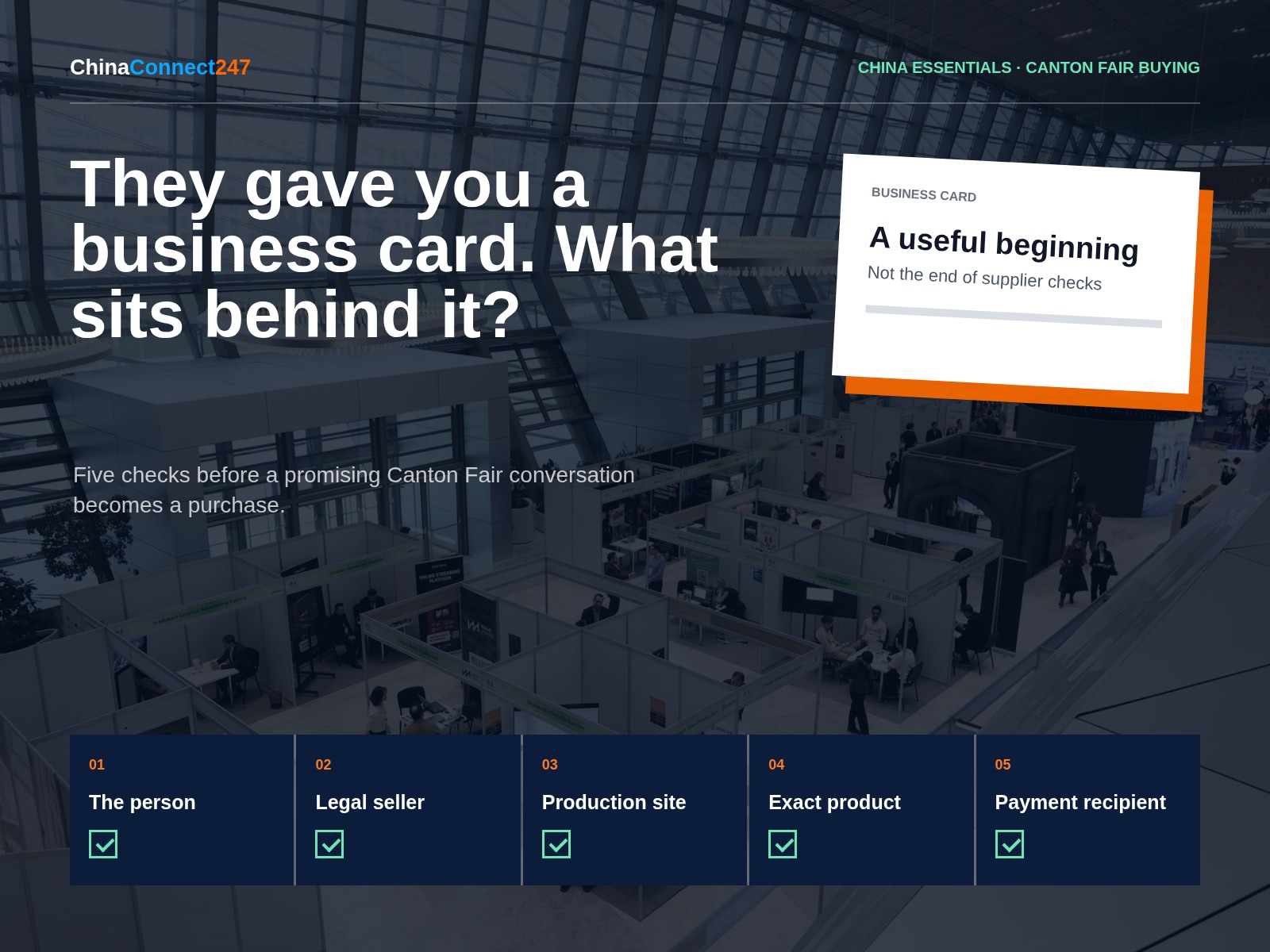
What to ask at Canton Fair before a promising conversation becomes a purchase.
Imagine this: you find a product that looks right for your business. The display is impressive. The person at the booth understands your questions, offers an attractive price, and hands you a business card.
You exchange WeChat details and walk away thinking, “I found my supplier.”
But several questions are still unanswered.
Does that person represent the company you would pay? Does that company manufacture the product? Who can approve changes? And does the sample in your hand represent what would arrive in your shipment?
A business card helps you continue the conversation. The next step is to establish what sits behind it.
Quick answer
Before moving toward an order, connect five things: the person you met, the legal seller, the production site, the exact product, and the payment recipient. Understand any differences between them and collect evidence proportionate to your order.
1. First, work out what this person can actually do
The right contact does not have to be the factory owner.
A capable salesperson can be an excellent partner if they understand your requirements, communicate accurately, and bring the right colleagues into the discussion.
What matters is knowing their role and the limits of their authority.
Ask:
- “Will you manage our quotation and order after the fair?”
- “Who approves changes to the product or packaging?”
- “Who can confirm technical specifications?”
- “Who handles quality problems?”
- “Who is authorised to approve the final commercial terms?”
These are coordination questions, not accusations.
Someone saying, “I need to confirm that with our engineer,” can be giving you a more useful answer than someone immediately agreeing to every request.
Ask for the name or role of the person who will confirm the detail, and agree when you will receive the answer.
A useful booth question:
“If we move forward, who will be responsible for our order from the approved sample through production and delivery?”
Record the answer beside the contact.
2. Ask who the seller is—not just what the brand is called
The name above the booth, the brand on the product, and the company on the quotation may differ.
That difference needs an explanation. It is not, by itself, proof of a problem.
For a mainland Chinese seller, ask for:
- Its full registered Chinese company name.
- Its business licence.
- Its Unified Social Credit Code.
- The legal company name that will appear on your contract and invoice.
Use the registered identity when arranging company checks. An English trading name alone may leave uncertainty about which entity you are researching.
China’s National Enterprise Credit Information Publicity System supports searches by enterprise name, Unified Social Credit Code, or registration number. A registration search helps establish identity; it does not establish that a company can successfully fulfil your particular order. Official enterprise-information search
You can also cross-check the company against official Canton Fair exhibitor information. The Fair’s own app provides exhibitor and product search and digital business-card exchange. Official Canton Fair app information
Use these checks as parts of the picture. An exhibitor listing does not answer your separate questions about production, product suitability, or payment arrangements.
3. “Are you a factory?” is only the beginning
Ask the question—but follow it with more specific ones:
“For this exact model, which processes do you perform yourselves, and which are handled by another company?”
Then ask:
- “Where will our order be produced?”
- “What is the legal name of that manufacturer?”
- “Is that your own facility, an associated company, or a supplier?”
- “Who controls the specifications and final inspection?”
- “Can we arrange a visit to the production site?”
A trading company may suit your needs if it can coordinate several products, organise communication, and take clear responsibility for its part of the transaction. A direct manufacturer may suit a project requiring close production involvement.
Evaluate the arrangement against your needs rather than automatically rewarding the word “factory.”
For example, if you need small quantities across several categories, coordination may matter greatly. If you need a customised component, access to engineering and production decisions may matter more.
The important question is whether the company can explain its role and support that explanation.
4. Check whether the supplier fits your order
A legitimate company can still be the wrong supplier for your project.
Before getting absorbed in price, explain:
- The exact product or application.
- Your destination market.
- Your expected first-order quantity.
- Any customisation or branding.
- Your required delivery window.
- Your essential quality requirements.
Then ask where your request falls outside its normal work.
Does your quantity meet its practical minimum? Has it handled the type of customisation you need? Can it provide the documents relevant to your market? Is the proposed delivery date a confirmed production commitment or an early estimate?
Give suppliers enough information to answer meaningfully.
“Can you make it cheaper?” invites a different conversation from:
“Which specification changes would reduce the cost, and what would those changes affect?”
Write down those trade-offs before comparing quotations.
5. Tie every promise to an exact product
A photograph and a price are not a complete specification.
Record the model number and the details that materially affect performance, cost, or compliance. Depending on the product, these could include:
- Materials and dimensions.
- Components or battery capacity.
- Voltage and plug type.
- Finish and colour.
- Accessories.
- Packaging.
- Branding.
- Warranty terms.
Ask:
“Is this price for the exact sample we are discussing? Please list any differences.”
Illustrative example—not a reported incident:
A buyer sees a rechargeable lamp at a booth. The demonstration uses one battery capacity, but the lowest quotation is for a smaller battery and different packaging.
Both sides may be discussing a real product while assuming different specifications.
Recording the model, configuration, and quotation basis makes that difference visible before it becomes a dispute.
For a shortlist, keep the product photo, specification, quoted quantity, currency, delivery term, and quotation date together.
6. Treat certification claims as questions to investigate
“We have certificates” is a starting point.
Ask which documents apply to the exact model and intended destination market. Request readable copies and check the company, model, issuing organisation, and scope.
Do not assume that every document carrying a laboratory logo establishes everything you need.
For example, EU guidance explains that CE marking applies only to products covered by relevant rules. The manufacturer must follow the applicable conformity-assessment process and prepare the required documentation and declaration. There is no central EU authority issuing universal permission to use the CE mark; the EU also warns about misleading voluntary certificates. European Union guidance on CE marking
A practical question is:
“Which documents support this exact model for sale in my destination country, and how can we verify them?”
Have a qualified specialist assess the requirements where needed. Do not infer compliance from the appearance of a logo on the product.
7. Before payment, connect the seller to the beneficiary
The conversation may start with a sales contact, while the eventual payment instructions name another company.
Pause and understand the relationship.
Request a written explanation when the beneficiary differs from the contracting seller. An associated company or export arrangement may explain it, but the explanation needs independent checking and appropriate documentation.
Be particularly careful when payment instructions change after you have already agreed them.
The FBI advises checking payment requests and changes to account details through a separate verification step, such as calling a trusted contact. Urgency and slightly altered email addresses are recognised warning signs. FBI guidance on business email compromise
Use a previously established or independently obtained contact number. Calling the number included in a suspicious payment-change message does not provide an independent check.
Meeting a real supplier at a real booth does not prevent someone from impersonating that supplier later.
8. Leave the booth with evidence you can use
You do not need to complete every check on the exhibition floor. You need enough information to decide what deserves further attention.
Before leaving a promising booth, capture:
- The contact’s name and role.
- The company name and booth number.
- The exact product and model.
- A product photograph, with permission.
- The quotation or agreed quotation request.
- Important supplier claims.
- Documents still outstanding.
- The next action and expected response date.
A useful note might read:
“Interested in model L20 for a first order of 300 units. Contact will confirm packaging options and send the legal seller’s details. Battery specification and destination-market documents still need review. Follow up on Tuesday.”
That note will be more useful after the fair than “Good supplier—nice products.”
Keep factual observations separate from impressions. “Showed a working sample” is an observation. “Reliable manufacturer” is a conclusion requiring more evidence.
9. Use warning signs to guide further checks
Pay closer attention when:
- Basic company details remain unclear after reasonable requests.
- Product specifications change between conversations and quotations.
- Important questions receive repeated vague answers.
- Documents cover another model or company without explanation.
- Payment details change unexpectedly.
- Pressure to commit increases while evidence remains unavailable.
A warning sign is a reason to investigate or pause. It is not automatically a finding of fraud.
Equally, do not treat a salesperson’s English fluency, personal messaging account, company size, or need to consult a colleague as a verdict on the business.
Assess the evidence and the supplier’s response to clear, reasonable questions.
10. Give each contact a next step
Avoid sorting every company immediately into “safe” or “unsafe.”
A more useful working shortlist is:
- Explore further: The product appears relevant; basic details still need collecting.
- Verify: The opportunity is promising; identity, capability, or documents need checking.
- Sample evaluation: You have enough clarity to assess a defined sample under agreed terms.
- Pause: A material inconsistency remains unresolved.
- Not a fit: The supplier does not suit your quantity, specification, timing, or commercial needs.
These are workflow stages, not safety ratings.
The U.S. International Trade Administration recommends careful partner selection and due diligence before building international business relationships. The amount of checking should reflect the transaction you are considering. ITA guidance on due diligence
Your aim at Canton Fair is to leave with promising opportunities and a clear path for evaluating them.
A message you can send after the fair
Hello [Name],
Thank you for speaking with us at booth [number]. We are interested in [product/model] for [destination market], with an initial quantity of approximately [quantity].
Please send your registered company name and business licence, confirm which company would contract with us, and identify where this model would be manufactured.
Please also provide a quotation for the exact specification discussed, including MOQ, packaging, sample cost, estimated lead time, and applicable product documents.
Finally, please confirm who will manage our order and who can answer technical and quality questions.
We will review the information and agree on the next step.
Keep the card. Keep the context with it.
After the fair, a stack of cards can become a collection of conversations you only partly remember.
Save the contact alongside the product, quote, questions, and next action. As evidence arrives, attach it to the same supplier record.
Open My Fair to keep your supplier contacts and sourcing follow-up organised. If you need help understanding a company or deciding what evidence to request next, tell ChinaConnect247 what you are sourcing.
ChinaConnect247 is independent of Canton Fair. This article offers general sourcing guidance; it does not verify any individual supplier or replace transaction-specific professional advice.
Sources and evidence
Open the original publications and product references used in this article.
Keep the context with the contact.
Save supplier cards alongside products, quotes, questions, samples, and the next action.