

Transport and maps
How to Get From Guangzhou Baiyun Airport to the Canton Fair
Compare metro, taxi and DiDi from Guangzhou Baiyun Airport to the Canton Fair, with luggage advice, practical timing and a late-arrival plan.
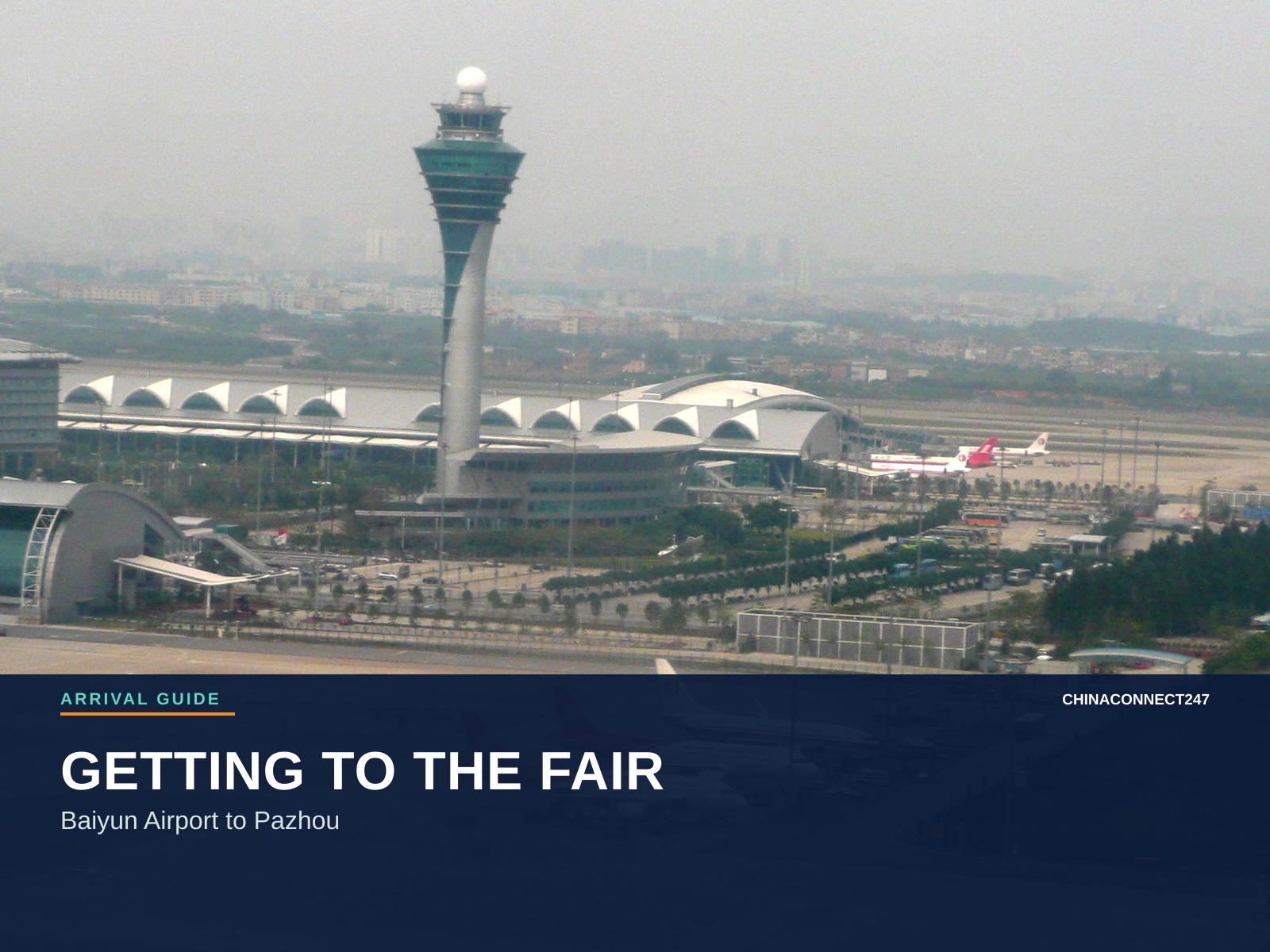
Arriving at Guangzhou Baiyun Airport with a suitcase and a fair schedule can make the first decision feel urgent: should you join the taxi queue, order a ride, or find the metro? The right answer depends on your terminal, arrival time, luggage, hotel and confidence with a transfer.
Quick answer
For most first-time visitors with manageable luggage, take Metro Line 3 from Airport South or Airport North to Kecun, transfer to Line 8, and use Pazhou for Areas B/C or Xingangdong for Area A. Allow roughly 60–90 minutes door to door. Choose the official taxi queue or a clearly identified ride-hailing pickup when carrying several bags, arriving late or travelling with a group.
The short answer
The Canton Fair Complex is in Pazhou, Haizhu District. Guangzhou government guidance describes the airport-to-Pazhou metro journey as about 43 minutes and the fare as about RMB 8, before your airport walk, transfer and final walk. In real planning, allow around 60–90 minutes from the terminal to a hotel or fair entrance.
A normal-traffic car journey can be around 30–60 minutes, but traffic and Canton Fair crowds can make it much longer. Treat any fixed taxi estimate as a planning guide, not a guarantee.
1. Metro: the predictable option for light luggage
From Terminal 1, start at Airport South. From Terminal 2, use Airport North. Take Line 3 toward the city and change at Kecun to Line 8 toward Wanshengwei.
- Get off at Pazhou for Areas B and C.
- Get off at Xingangdong for Area A and nearby eastern entrances.
- Follow the signs for the complex and confirm your hall or registration point before leaving the station.
The trains avoid road congestion and the fare is usually the clearest part of the cost. The trade-off is carrying bags through the airport, a transfer station and a busy exhibition area.
2. Taxi: easiest with bags or a tired group
Use the official airport taxi rank. Have your hotel name, address and phone number in Chinese characters ready, preferably as a screenshot. If you are going directly to the complex, use the address No. 382 Yuejiang Middle Road, Haizhu District and specify your area or entrance.
A taxi is often the least stressful choice when you have multiple suitcases, samples, a child, mobility needs or a late arrival. It is not necessarily the fastest during morning traffic or the opening days of a fair. Ask the driver to use the meter and keep the receipt.
Do not judge the journey by the official normal-traffic estimate. Build a larger buffer during fair periods, rain and commuting peaks.
3. DiDi: useful when you can manage the pickup
DiDi can make the destination and price easier to manage in the app, but airport pickup instructions can be less intuitive than a taxi rank. Set up the service before flying, confirm the payment method and check the designated pickup floor or zone shown in the app.
If your phone or data plan is not working after landing, a taxi is the better fallback. Do not walk away from the official pickup area with a stranger who says they are your driver. Match the vehicle and plate shown in the app.
For a first trip, DiDi is most useful when you already have a working local-app setup, a reliable data connection and the Chinese address for your destination.
Metro versus car
- Better starting choice
- Metro
- Why
- Predictable and low cost
- Better starting choice
- Taxi or DiDi
- Why
- Fewer stairs, transfers and long walks
- Better starting choice
- Taxi or DiDi
- Why
- The fare can be easier to share
- Better starting choice
- Metro
- Why
- Avoids road delays
- Better starting choice
- Taxi or DiDi
- Why
- Door-to-door after checking service availability
- Better starting choice
- Official taxi
- Why
- The rank is easier to find than a digital pickup
| Situation | Better starting choice | Why |
|---|---|---|
| One small suitcase, daytime arrival | Metro | Predictable and low cost |
| Several bags or heavy samples | Taxi or DiDi | Fewer stairs, transfers and long walks |
| Three or four travellers | Taxi or DiDi | The fare can be easier to share |
| Arrival during heavy traffic | Metro | Avoids road delays |
| Late arrival | Taxi or DiDi | Door-to-door after checking service availability |
| First visit with no working data | Official taxi | The rank is easier to find than a digital pickup |
4. What to do with luggage
Metro is possible with luggage, but the final walk can matter more than the train ride. Check whether your hotel has an elevator, whether the station exit has stairs and whether you need to cross a large road or exhibition forecourt.
For large cases, samples or fragile items, a car reduces handling. Keep passports, electronics, samples and documents with you rather than in an unattended vehicle boot when practical.
If you are going to the fair before checking in, consider whether your hotel can store bags. The venue and nearby stations can be very busy during opening periods, so do not assume you can move quickly with a trolley.
5. Arriving late
Before departure, check the last practical metro connection for your terminal and date. Do not rely on a generic timetable if a flight delay is possible. If you land after your planned metro window, use the official taxi rank or a pre-arranged, identifiable transfer.
Keep these offline:
- Hotel name, address and phone number in Chinese.
- Flight and booking references.
- A screenshot of your route.
- A second contact method.
- Some payment backup.
If you use DiDi, confirm that your data plan, account and payment method work before leaving the airport.
A first-time visitor recommendation
For a first visit with a normal arrival time and one manageable case, take Line 3 to Kecun and Line 8 to the station that matches your area. For a late landing, several bags or a hotel that is not close to a station, use a licensed taxi or correctly matched DiDi. The easiest route is the one that still works after you add your luggage, hotel walk and arrival time.
Travel times and operating details can change. Recheck Guangzhou Metro, airport and Canton Fair information for your travel date.
What to do between landing and leaving the airport
The route decision is easier if you work through the airport in order rather than choosing a vehicle while still tired from the flight.
- Finish arrival formalities and collect every bag. If a suitcase is delayed, record the baggage reference before leaving the arrivals area. A missing bag changes the metro-versus-car decision.
- Get connected. Turn on the travel eSIM or roaming line you prepared, and check that a map, your booking and your chosen transport app can load. Keep your home SIM available for verification if needed, but avoid accidental data roaming.
- Open your offline backup. Find the hotel address, the Chinese destination name and the phone number. Do not depend on an email link that may not load.
- Decide how far you are really travelling. A hotel near Kecun is a different journey from the Canton Fair Complex. Use the destination, not only the district name, when comparing routes.
- Choose one primary route and one fallback. For example: metro if the airport-to-station walk is manageable; official taxi if the queue, bags or time make that more sensible.
Airport signs are generally more useful than trying to follow a screenshot from a different terminal. Look for the current metro, taxi and ride-hailing signs after you enter the public arrivals area.
Three realistic arrival scenarios
Scenario A: one traveller, one case, daytime arrival
You land on time, your phone works and your hotel is close to Pazhou or Kecun. Take the metro if you are comfortable with one transfer. Keep the route open on your phone, but also save the station names in Chinese. Allow time for the airport walk and for finding the correct exit at the destination.
This is usually the clearest low-cost option. It also lets you avoid guessing how long the road will take during a busy fair morning.
Scenario B: two buyers with samples and full luggage
A taxi or DiDi will usually be easier because the group can keep sample cases together and go directly to the hotel. Compare the total fare with two metro fares, but do not reduce the decision to price. The value is in avoiding stairs, platform changes, crowded trains and a long walk after the transfer.
Put the hotel address in Chinese on the booking confirmation and check that the driver is taking you to the correct branch if the hotel has more than one location.
Scenario C: a delayed late-night flight
Do not force a metro journey because it was the original plan. Check the current operating window and use an official taxi or a pre-arranged transfer when the remaining connection is uncertain. If you are staying outside the Pazhou area, ask the hotel about late check-in before boarding the flight.
Keep your passport, booking reference and payment backup accessible. A tired arrival is exactly when a confusing pickup message or an unfamiliar hotel entrance creates avoidable stress.
If you are carrying fair samples
Samples can make a normal suitcase awkward. Before choosing the metro, consider the case size, wheels, stairs, platform crowding and whether you can keep the item beside you. Fragile or valuable samples should remain in your possession and be protected from compression.
If a supplier has given you catalogues, brochures or small samples, group them in a labelled folder or soft case. Keep a simple note with the supplier name and booth number so you can identify the contents later. Avoid placing passports, electronics or irreplaceable documents in a case that may be separated from you.
For a large first-day haul, ask the hotel about luggage storage and whether it can arrange a local delivery or car. Do not assume the exhibition complex will provide the exact storage service you need.
Common first-arrival mistakes
- Entering “Canton Fair” into a ride-hailing app without checking the area or hotel address.
- Choosing a metro route without allowing for a terminal walk and the Kecun transfer.
- Assuming a taxi’s normal-traffic time will hold during the fair opening rush.
- Leaving the airport without an offline hotel address in Chinese.
- Relying on a payment app that has not been verified before landing.
- Accepting an unofficial ride because the official queue looks long.
- Forgetting that the last walk from the station can be difficult with a heavy case.
The best arrival plan is deliberately boring: a known address, a working connection, a payment fallback and enough time to change your mind.
A simple arrival card to prepare
Write or save this information before your flight:
- Airport terminal and arrival flight.
- Hotel name, address and phone number in Chinese.
- Intended station and exit, if using the metro.
- Canton Fair area, hall and meeting point, if travelling directly there.
- Metro route: Airport South/North → Line 3 → Kecun → Line 8.
- Primary payment method and backup payment method.
- Hotel late-check-in contact.
- Emergency contact and a second messaging route.
Times, terminal arrangements, metro operating windows and pickup zones can change. Check the current official information close to departure.
Sources and evidence
Open the original publications and product references used in this article.
Keep the context with the contact.
Save supplier cards alongside products, quotes, questions, samples, and the next action.